
A victory and a claim
Brahman wins a victory for the devas. Yet in the brightness that follows, they look at one another and say, in effect: this victory is ours; this greatness belongs to us.
The Upanishad begins at the instant achievement becomes possession. The devas are powerful, but they mistake the power moving through them for something produced and owned by themselves.
The being no one knows
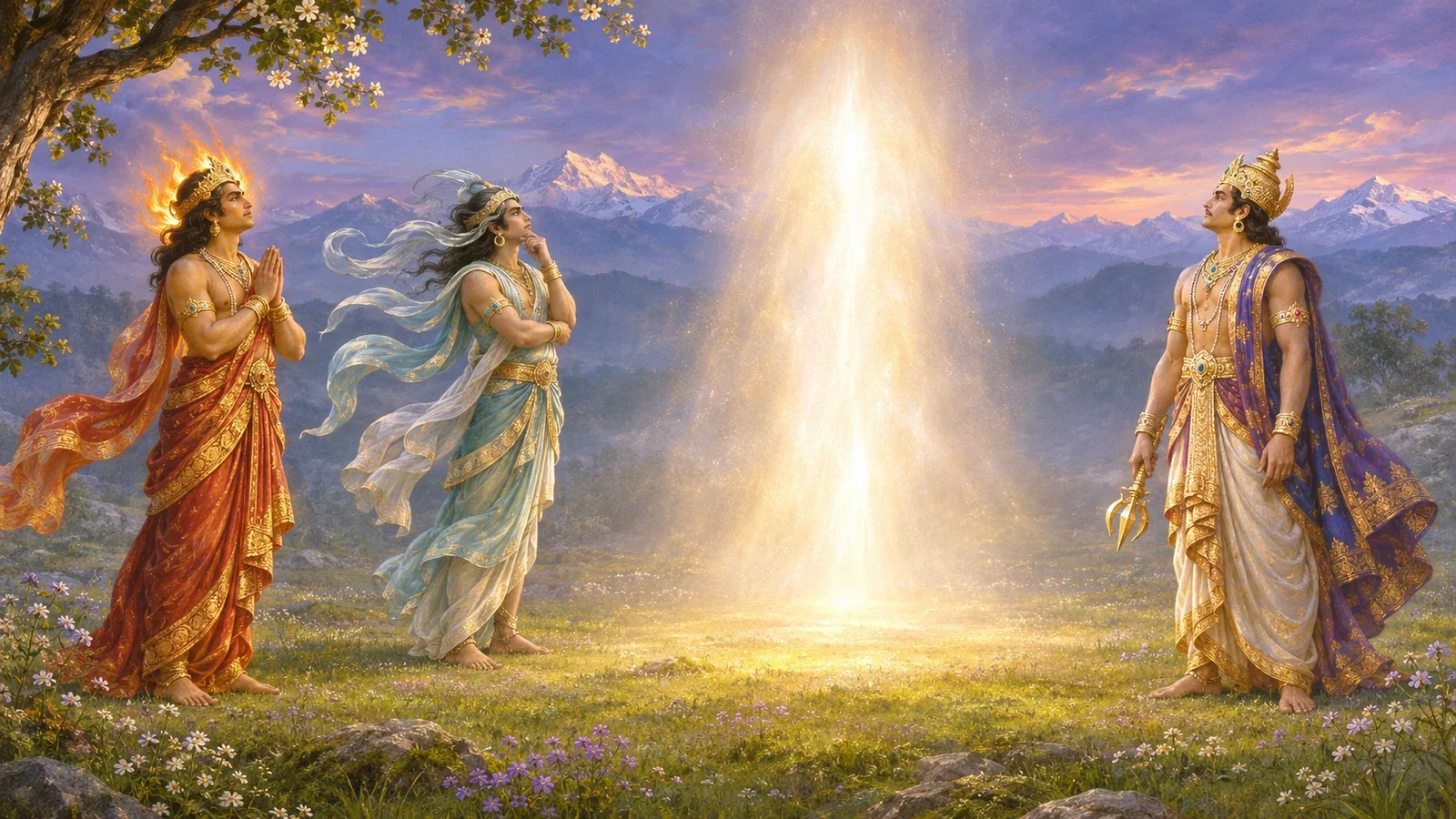
A mysterious Yaksha appears before them. The devas see the presence, but none can say what it is. Their knowledge has reached its edge.
They turn first to Agni. “Discover who this being is,” they ask. The fire-deva goes forward with the assurance of one whose power has never seemed doubtful.
Agni steps forward
The Yaksha asks, “Who are you?” Agni answers with his names: he is Agni, he is Jatavedas, the knower of what is born. Asked what power belongs to him, he declares that he can burn everything upon the earth.
The question has not merely requested a title. It has exposed the identity Agni has built around an ability. The Yaksha does not argue with the claim. Instead, the presence places a single blade of grass before him.
One blade of grass
“Burn this.” Agni rushes at the blade with all his force. It does not burn. The smallest object has become an impossible measure.
Agni returns to the devas. He does not pretend success. He says that he could not discover what the Yaksha was. His failure begins to open a space that pride had closed.
Vayu meets the same measure
Now the devas send Vayu. The Yaksha asks the same questions. Vayu names himself Matarishvan and says that he can carry away everything upon the earth.
The blade of grass is placed before him. “Carry this away.” Vayu bears down upon it with all his force, but the blade does not move. He too returns without knowing the presence before which his power has failed.
Indra approaches
The devas then ask Indra to find out who the Yaksha is. Indra goes toward it. Before he can repeat the claims of Agni and Vayu, the presence vanishes.
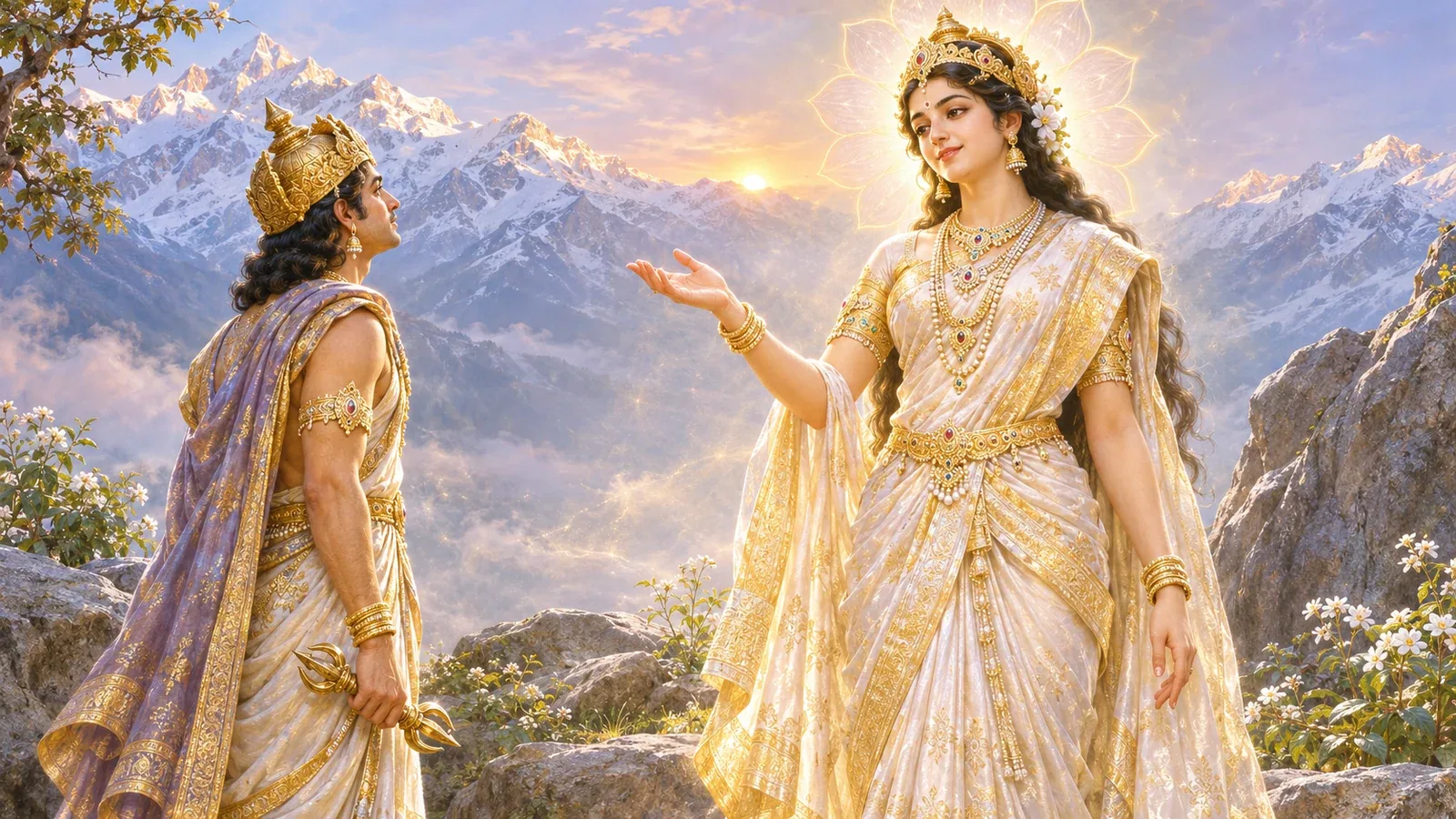
This disappearance does not end the inquiry. Indra remains in the open space where certainty has been removed. There he sees a woman of great radiance: Uma Haimavati.
Uma Haimavati reveals the truth
Indra asks her who the Yaksha was. Uma answers: it was Brahman. In Brahman’s victory, the devas had become great.
The scene turns revelation into relationship. Agni and Vayu learn the limit of the powers they claimed; Indra learns by asking; Uma speaks the knowledge that makes recognition possible. She is not a decorative witness to the teaching. She is its revealer.
What the encounter teaches
The Upanishad honours Agni, Vayu and Indra because they came nearest to the mystery and first knew it as Brahman. Indra is distinguished because he approached most closely and received Uma’s disclosure.
The teaching then shifts from story to contemplation. Brahman is intimated like the sudden brightness of lightning, like the blink of an eye, and inwardly through the mind’s repeated turning toward it. The text names Brahman as Tadvanam—that which is worthy of adoration—and grounds the teaching in disciplined practice, the Vedas and truth.
The devas do not lose their dignity when their independence is questioned. Their powers are returned to a deeper source. The story therefore asks not whether ability is real, but whether ability has mistaken itself for the whole.
EDITORIAL REFLECTION / PAUSE & REFLECT
What changes when
ability becomes gratitude?
The devas’ error is not that they can do nothing. It is that they treat a received power as self-created and complete. Where in your own work might recognition of sources, teachers and conditions deepen rather than diminish achievement? This is an editorial invitation, not a translated verse.
TEXT & INTERPRETATION
A luminous episode.
A teaching larger than one image.
This reader follows the supplied edition with Shankara’s commentary. Vedanta traditions interpret Brahman, divine power and knowledge in distinct ways; this page does not claim to exhaust those readings. “Brahman” here means ultimate reality, not the deity Brahma.
The Upanishad does not describe the Yaksha’s body or give a detailed setting. The Himalayan landscape, clothing and luminous form in the illustrations are devotional interpretations. The hero combines Agni, Vayu and Indra in one symbolic scene although their encounters unfold in sequence.
Read the passage map and edition notes