
Janaka’s assembly
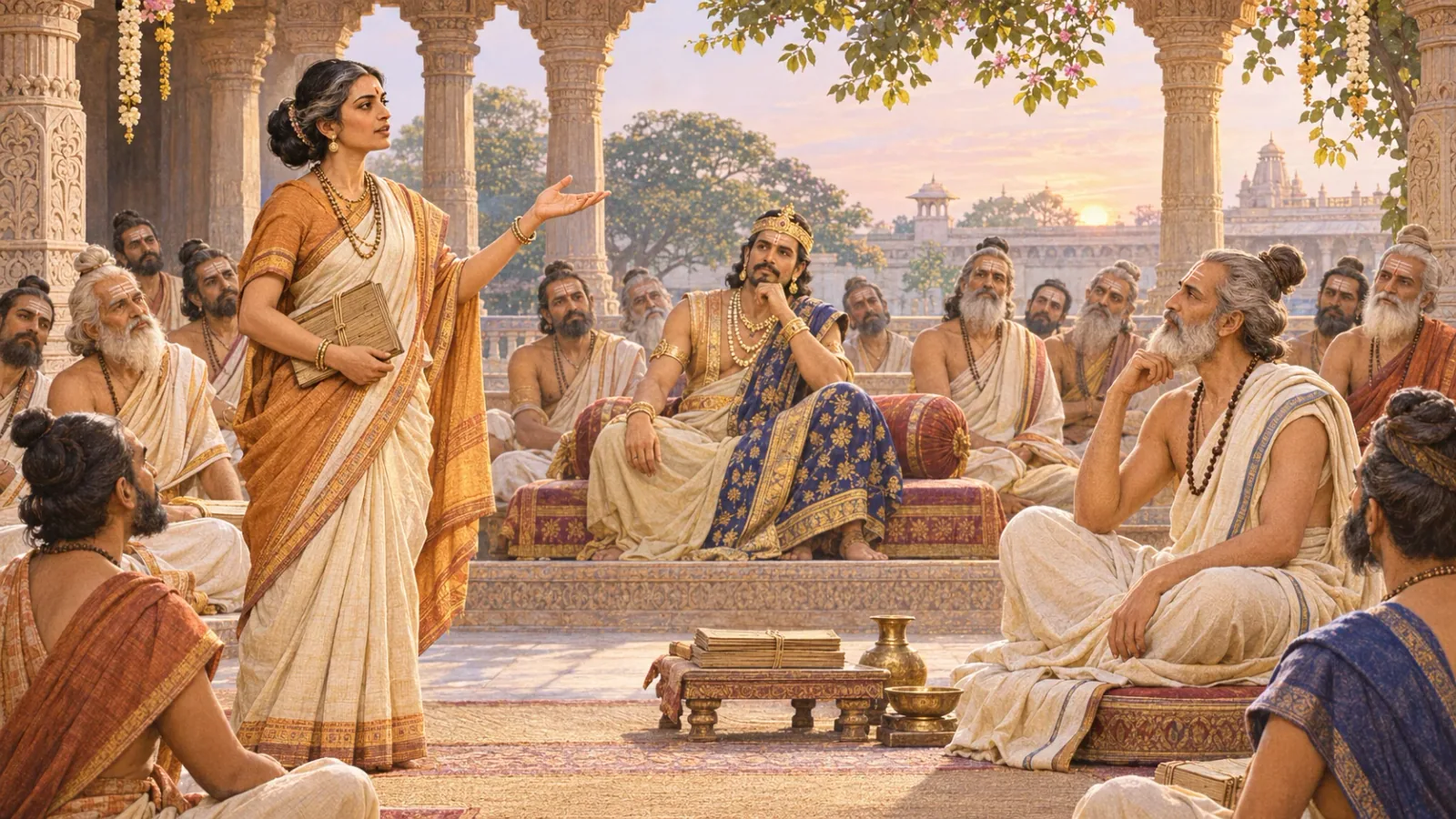
King Janaka of Videha performs a great sacrifice and gathers learned brahmins from Kuru and Panchala. A thousand cows stand nearby, gold fastened to their horns. Janaka announces that whoever is most deeply learned may take them.
The prize makes knowledge public and testable. It is not enough to possess a reputation. Whoever steps forward must be ready to answer before the assembly.
A bold claim
Yajnavalkya tells his student to drive the cows away. The other scholars object: does he truly claim to be the wisest among them? Yajnavalkya does not offer a speech of self-praise. He says he honours the most learned—but he wants the cows.
One questioner after another now tests him. The debate travels through ritual, breath, death, self and liberation. Among those who rise is Gargi Vachaknavi.
Gargi’s first questioning
Gargi begins with a traditional image: if the world is woven through water like warp and weft, in what is water woven? Yajnavalkya answers, and she continues. Water gives way to air; air to the intermediate regions; these to subtler worlds in an ascending sequence.
Her inquiry refuses to stop at the first supporting layer. Every answer becomes the ground of a further question: what, in turn, supports this?
The limit of a question
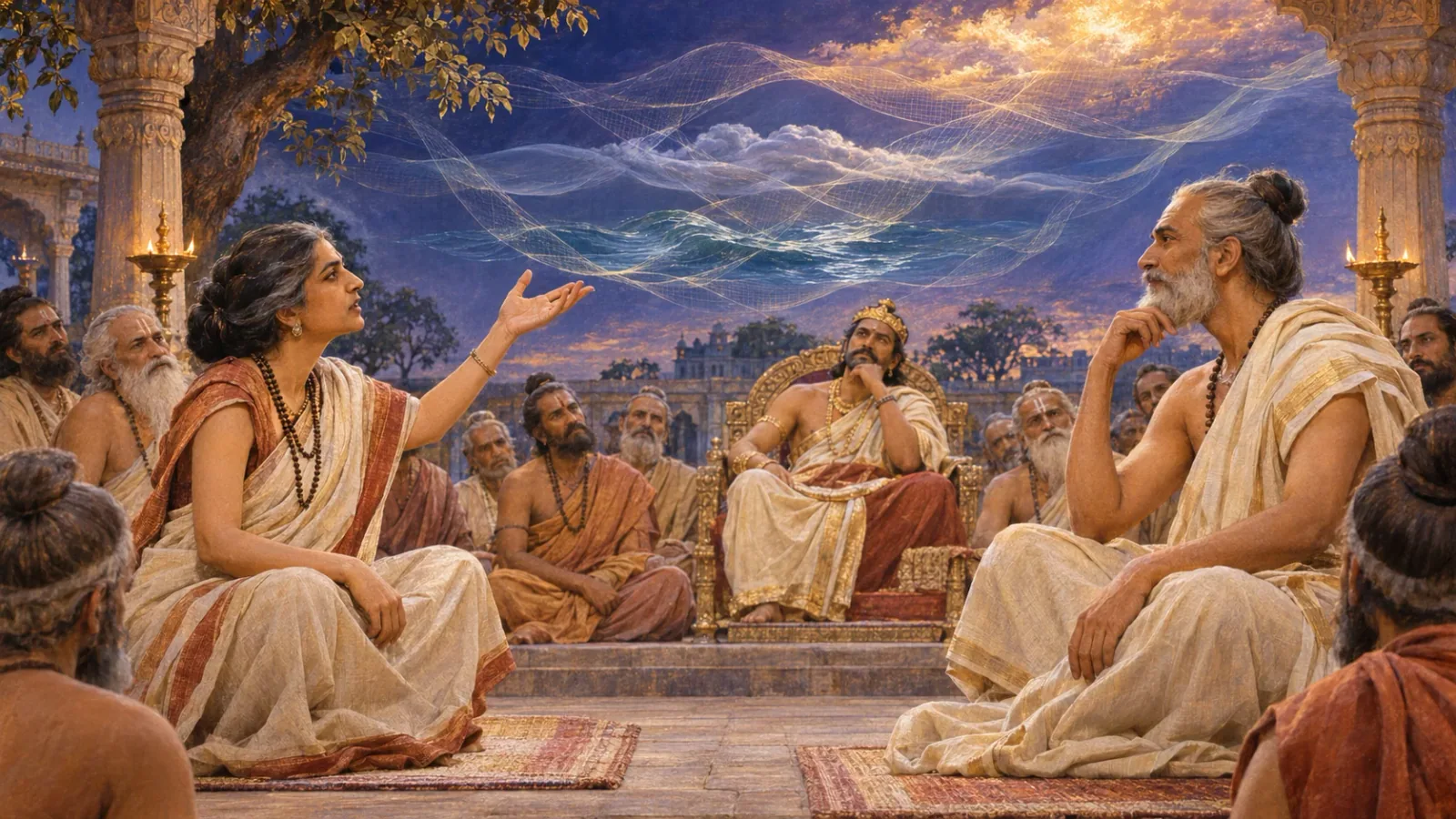
Gargi’s sequence reaches the world of Brahman and asks what lies beyond it. Yajnavalkya warns her not to press the question in a way that treats what is beyond ordinary questioning as one more object in the chain.
Gargi stops. The moment is severe, and the text’s warning should not be softened into a casual interruption. Yet it is not her final word. After other scholars question Yajnavalkya, Gargi rises again with a more exact approach.
Two questions like arrows
Gargi addresses the assembly. She will ask Yajnavalkya two questions, she says, like a warrior of Kashi or Videha stringing a bow and taking two formidable arrows in hand. If he answers them, none present will defeat him in a debate about Brahman.
She asks what is above heaven, below earth and between them—what includes what people call past, present and future. In what is all this woven, warp and weft?
What is woven in space?
Yajnavalkya answers: all this is woven in akasha—space or the vast expanse. Gargi acknowledges the answer, then releases her second question.
In what, then, is akasha itself woven? The question no longer asks for another visible region or named cosmic world. It asks for that upon which even the field of all appearances depends.
The imperishable
Yajnavalkya answers that knowers of Brahman call it the Imperishable—the akshara. His teaching proceeds by refusing every easy category: it is neither gross nor subtle, neither short nor long, without the ordinary marks by which objects are grasped.
Yet this is not mere emptiness. Under the governance of the Imperishable, the sun and moon remain in their courses, heaven and earth hold their places, moments and seasons unfold, and rivers move from their sources. It is the unseen seer, the unheard hearer, the unthought thinker and the unknown knower. Nothing else stands behind it as another seer or knower.
Gargi’s recognition
Gargi turns to the assembled brahmins. They should consider themselves fortunate if they can depart after offering Yajnavalkya respect, she tells them; none of them will defeat him in debate concerning Brahman.
Her recognition is not surrender to status. It follows a public test conducted with precision. Gargi’s role is indispensable: by refusing shallow closure, she draws the discussion from layered cosmology toward the Upanishad’s teaching on the imperishable ground of experience.
EDITORIAL REFLECTION / PAUSE & REFLECT
What remains when
every support is questioned?
Gargi does not ask only for more information. She tests whether each explanation rests upon something still deeper. Which of your own assumptions have become invisible because you have never asked what supports them? This is an editorial invitation, not a translated verse.
TEXT & INTERPRETATION
A debate in two movements.
Not one continuous exchange.
This reader preserves the distinction between Gargi’s first questioning in 3.6 and her later two questions in 3.8. Other learned interlocutors question Yajnavalkya between these passages. The page follows the supplied Gita Press edition with Shankara’s commentary while recognising that Vedanta traditions interpret Brahman, akshara and the relation of self and ultimate reality differently.
The court, clothing and faces in the illustrations are imagined. The woven sky is a conceptual metaphor, not a literal diagram from the text. Brahman and the Imperishable are deliberately not personified.
Read the passage map and edition notes