
A kingdom held lightly
Ambarisha rules a vast and prosperous realm, yet the Bhagavata says he regards its rare wealth as dreamlike. Possession does not become the centre of his identity.
His devotion is described through the whole person: mind fixed on Krishna’s feet, speech used for divine praise, hands used in service, ears turned toward sacred accounts and eyes toward holy images and places. Royal power becomes a field of service rather than self-importance.
A year-long vow
With his queen, Ambarisha undertakes a year-long observance of Ekadashi and Dvadashi devoted to Vishnu. At its completion he worships, honours learned guests, gives richly and prepares to end the fast at the appointed time.
The sage Durvasa arrives with many disciples. Ambarisha welcomes him and invites him to eat. Durvasa accepts, then goes to the Yamuna to bathe and perform his rites.
The difficult moment
Durvasa does not return before the sacred time for completing the vow is about to pass. Ambarisha now faces two duties that seem to pull against each other: he should not eat before his honoured guest, yet he should not allow Dvadashi to end without completing the observance.
After consulting the brahmins, he takes only water. Water can be understood as both eating and not eating, making it the narrowest possible course between the obligations. Then he waits for Durvasa, without beginning the meal.
Durvasa’s anger
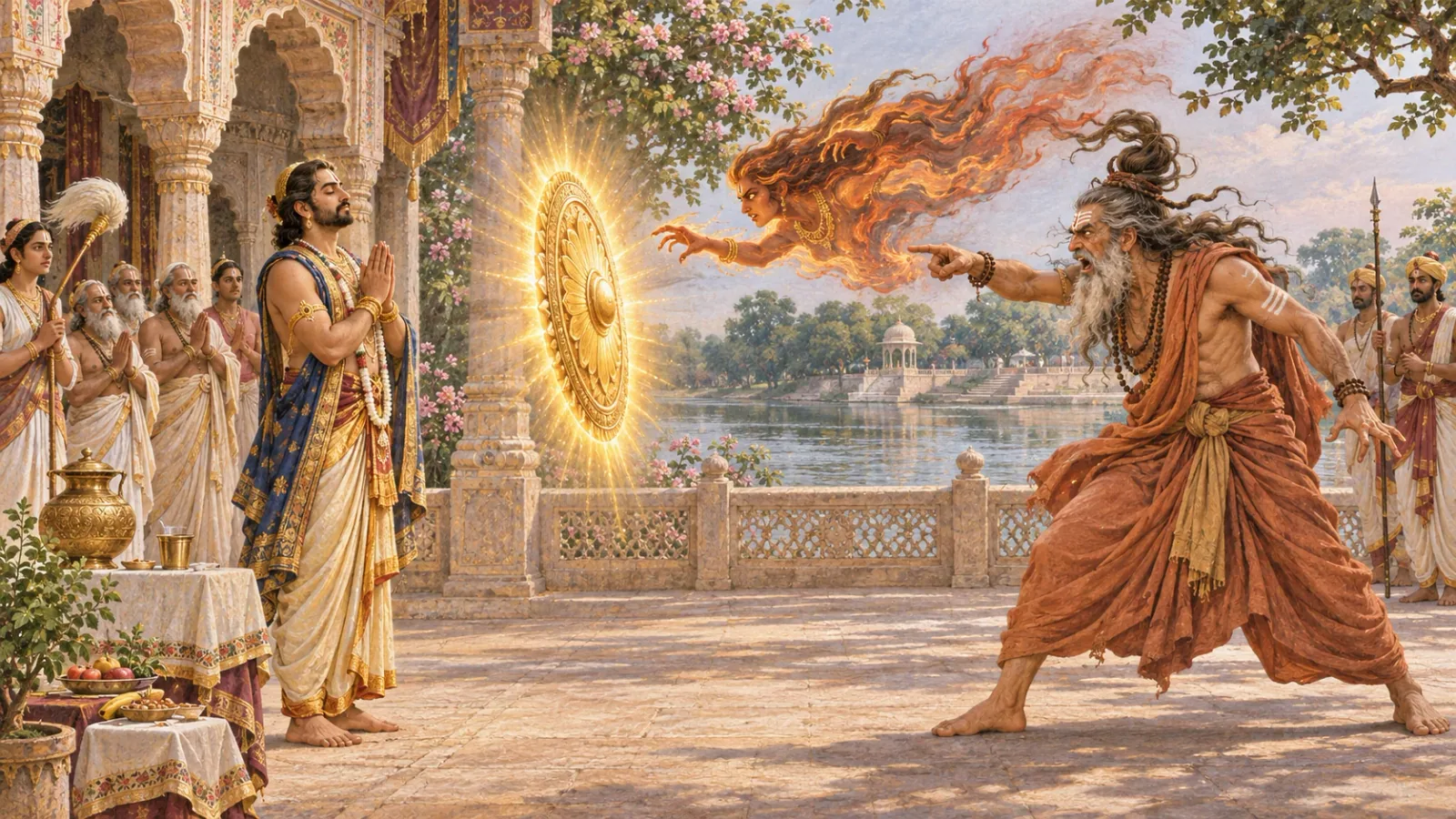
When Durvasa returns, he understands that Ambarisha has taken water. He reads the act not as restraint but as arrogance and disrespect. Anger takes command before explanation can.
The sage tears a lock from his matted hair and creates a fiery being to destroy the king. Ambarisha does not flee or raise a weapon. He remains where he is, composed before the danger.
Vishnu’s Sudarshana destroys the fiery attacker and turns toward Durvasa. Protection now becomes pursuit.
No refuge from Sudarshana
Durvasa flees across the earth and through the heavens, but the radiant discus remains close behind. He seeks refuge first with Brahma and then with Shiva. Neither claims the power to stop what has been set in motion.
At last Durvasa reaches Vishnu’s abode and falls before the Lord. The sage who had arrived at Ambarisha’s court as an honoured guest now asks to be protected from the consequence of his own anger.

Vishnu’s answer
Vishnu tells Durvasa that he is deeply bound by the love of his devotees. Those devotees have placed their trust in him and given up every other shelter; their welfare is therefore not separate from him.
The Lord does not simply dismiss Sudarshana. He directs Durvasa back to Ambarisha. The way out of the crisis lies with the person against whom the offence was committed. Divine refuge does not erase the need for reconciliation.
Ambarisha prays
Durvasa returns and grasps Ambarisha’s feet in distress. The king is embarrassed to see the sage bow before him. Rather than claiming victory, Ambarisha turns immediately toward Sudarshana in prayer.
He praises the discus through sacred powers and offers the merit of his own devotion for Durvasa’s safety. The protection that answered violence is asked to become mercy. Sudarshana withdraws its heat.
The guest is fed
Durvasa praises the greatness of devotion: though he had wronged Ambarisha, the king sought his well-being. Ambarisha then serves him the waiting meal.
Only after Durvasa and his disciples have eaten does the king take food himself. The Bhagavata adds that Ambarisha had waited through Durvasa’s year-long absence, sustaining himself on water while hoping for the sage’s return.
The story closes without pretending that anger caused no harm. Its resolution comes through a sequence of recognitions: Durvasa sees his error, Vishnu sends him back, Ambarisha refuses triumph, and hospitality is finally completed.
EDITORIAL REFLECTION / PAUSE & REFLECT
Protection without
the desire to defeat.
Ambarisha is protected, but he does not use that protection to humiliate the person who attacked him. What might strength look like when its aim is safety, truth and eventual repair rather than victory over another? This is an editorial invitation, not a translated verse.
TEXT & INTERPRETATION
Devotion, consequence
and restored hospitality.
This reader follows the Bhagavata Purana’s Vaishnava account in Skandha 9. Vishnu’s bond with his devotees and Sudarshana’s protection belong to that theological setting. The story is not presented as permission for anger, retaliation or self-righteousness.
The supplied text describes Ambarisha’s water as a carefully chosen response to a conflict of duties. This page does not turn that episode into general fasting or medical advice. The palace, clothing, journey through the worlds and visual form of the fiery being are artistic interpretations.
Read the passage map and supplied-edition notes