Six short retellings for reading aloud together. Pause after each story, listen to one another’s questions, and follow the links when you want to explore the fuller account.
READ TOGETHER / COMPASSION
Shiva protects the worlds
The devas and asuras churned the Ocean of Milk, hoping to find nectar. They used Mount Mandara as their rod and the serpent Vasuki as their rope. Vishnu, in the form of the tortoise Kurma, supported the mountain.
But a terrible poison called Halahala emerged. As it spread, frightened beings sought Shiva’s protection.
Shiva saw their suffering and spoke with Bhavani, the Goddess beside him. She knew his divine power and consented to his action. Shiva received the poison and drank it to protect living beings.
A blue mark appeared on his throat. It is remembered in the name Nilakantha, “the blue-throated one.” The story celebrates Shiva’s compassion.
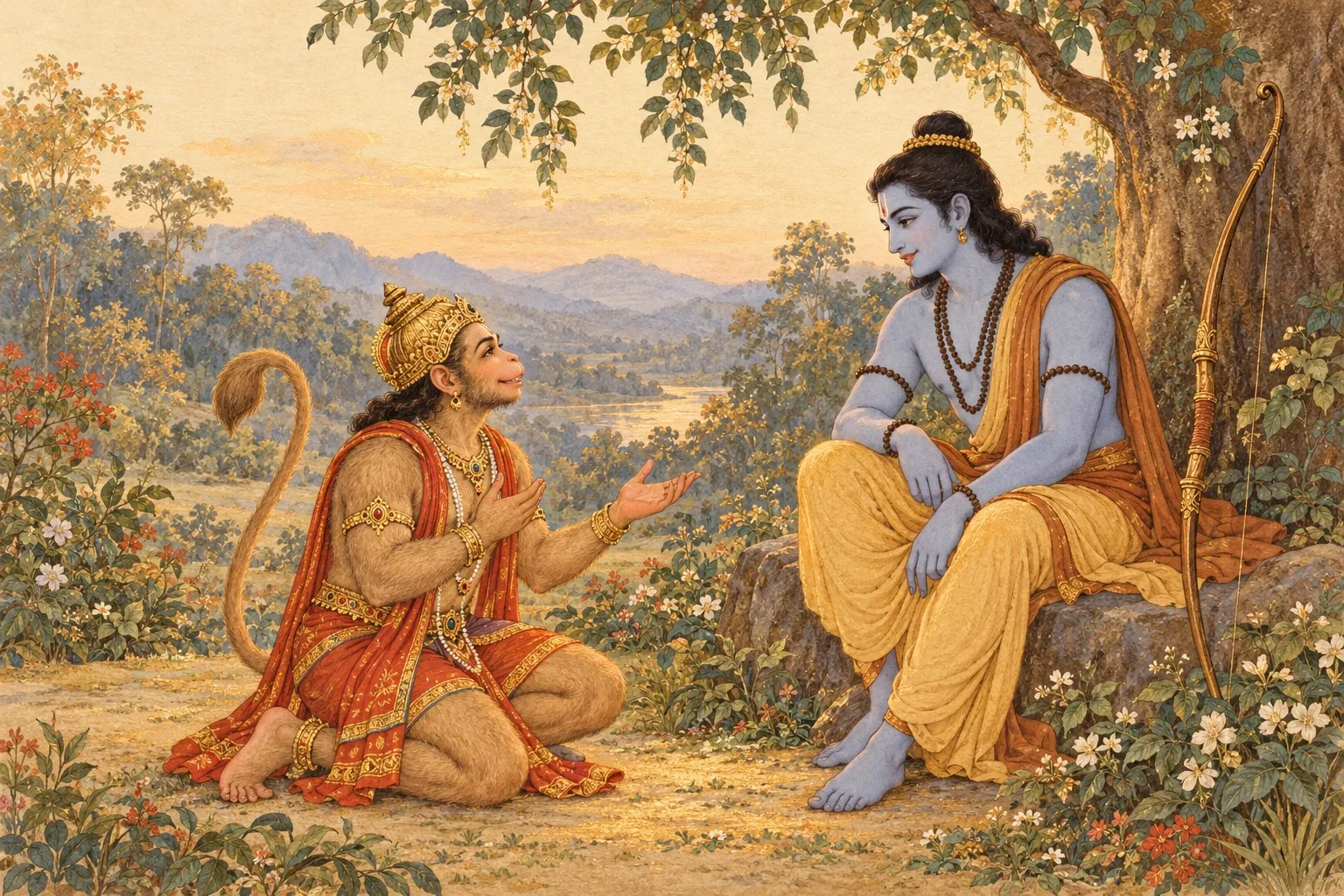
Hanuman set out across the ocean to search for Sita, who had been taken to Lanka. His purpose was to help Rama find her.
The mountain Mainaka rose from the sea and offered him rest. Hanuman thanked him, but continued his urgent journey.
Surasa appeared to test him. As she opened her mouth wider, Hanuman grew larger. Then he changed his approach: he became tiny, entered her mouth and slipped out again. He had met the challenge through quick thinking. Surasa blessed his mission.
Another danger, Simhika, caught his shadow. Hanuman overcame her and continued across the sea. At last he reached Lanka, where the search for Sita could begin.
His search continued within Lanka. He found Sita, showed her Rama’s ring, and later returned with her message. The illustration recalls that later moment of reunion with Rama.
His journey needed strength, but it also needed gratitude, attention and judgment.
Dhruva was a young prince. When someone in the royal household spoke hurtfully to him, he felt deeply upset and wished to prove himself. His mother, Suniti, encouraged him to seek the Lord rather than let his sorrow be the whole story.
Dhruva went to the forest. The sage Narada met him, listened to his resolve and gave him guidance for devotion and discipline. Dhruva followed the path with patience in Madhuvana.
Vishnu appeared before him. What Dhruva first wanted was no longer the most important thing to him. The encounter helped him see beyond the hurt that began his journey.
Rama was preparing for a new responsibility in Ayodhya. But King Dasharatha had made promises that required a change: Rama was to live in the forest for fourteen years, while Bharata would be made king.
Rama accepted the exile. Sita chose to accompany him, explaining that her place was with him. Lakshmana, Rama’s brother, also chose to go. Their departure brought sorrow to the family and the people of Ayodhya.
The journey reminds readers that decisions can involve duty, love and difficult feelings at the same time. The fuller Ramayana gives each person a voice and a part in what follows.
The people of Vraja lived close to their cows, fields and Govardhana Hill. Krishna spoke with the elders about how they cared for their community and the land that supported them.
A powerful storm threatened the village. Krishna lifted Govardhana Hill and sheltered the people and cattle beneath it. Families gathered together until the danger passed.
The account also tells of pride giving way to recognition. For a family reading, it opens a conversation about shelter, gratitude and looking after one another.
The devas had lost their places because of the powerful Mahishasura. They came together in distress. A great radiance arose, and the Goddess appeared.
The gods honoured her and entrusted weapons to her. Riding her lion, the Goddess confronted Mahishasura, whose form could change. After the struggle she prevailed, and the devas praised her.
This version belongs to the Devi Mahatmya. It honours the Goddess as protection and refuge; other Goddess texts may tell different accounts.
Use your browser’s Print command to print this companion or save it as a PDF. The print edition keeps all six short stories and their discussion questions together.
Try drawing one moment from a story, explaining why you chose it, or writing down a new question for your next reading.