
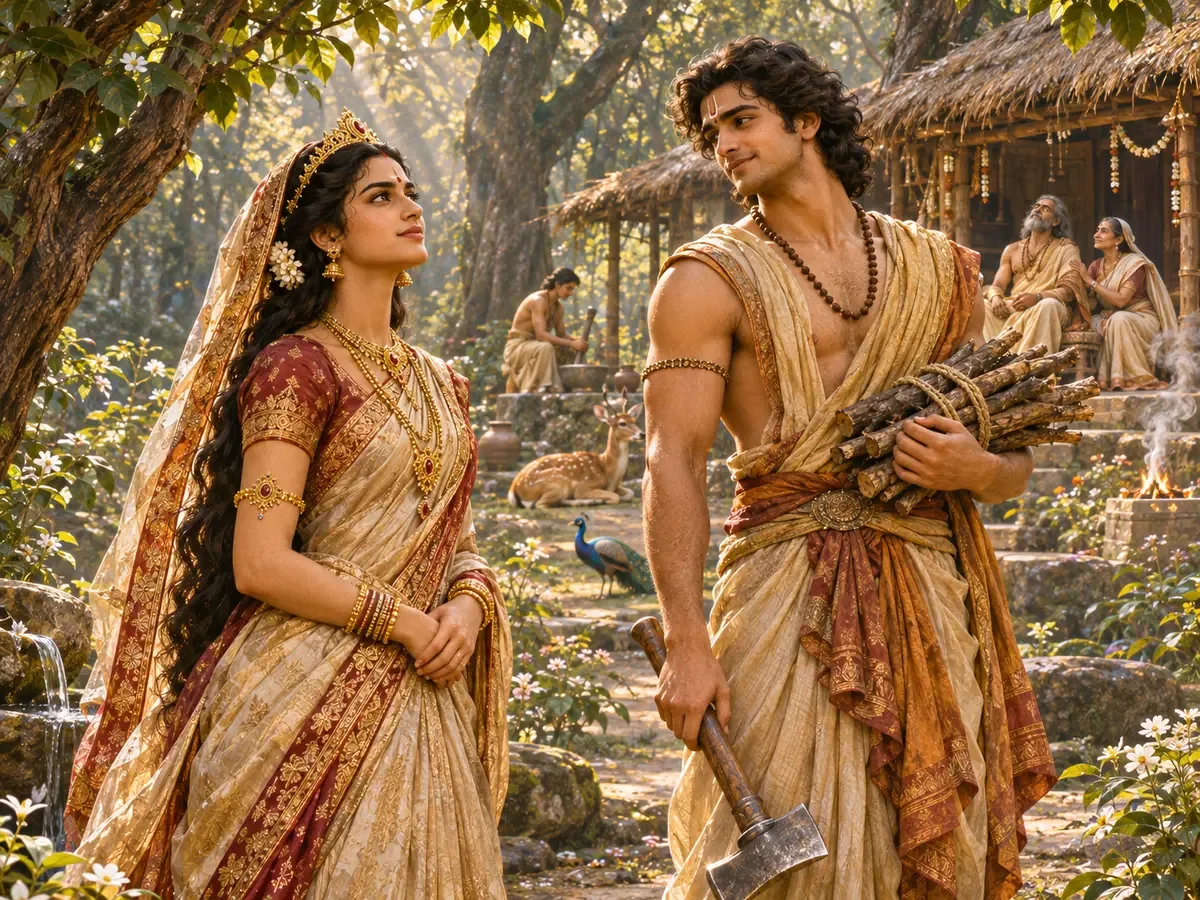
The Daughter Named Savitri
Vana Parva 293.1–41 · PDF pp. 1963–1969
In the forest, King Yudhishthira spoke to the sage Markandeya of a sorrow that weighed upon him more heavily than his lost kingdom. He thought of Draupadi: of the humiliation she had endured during the dice game, and of the danger she had faced when Jayadratha carried her away. Had Markandeya ever heard of a woman whose steadfastness could be compared to hers?
Markandeya answered with an older account. He would tell Yudhishthira about Savitri.
Long ago, King Ashvapati ruled the land of Madra. He was known for keeping his word, governing with care, and observing religious duties. Yet, as the years passed, he had no child. Hoping for a son or daughter, he undertook a prolonged discipline of worship associated with the goddess Savitri. Eighteen years passed in that observance. At last the goddess appeared and told him that a radiant daughter would be born to him.
In time, Queen Malavi gave birth to a girl. Because the child had come through the blessing of the goddess Savitri, she too was named Savitri.
Savitri grew in grace, intelligence and striking radiance. When she reached the age of marriage, however, no suitor came forward. Her father was troubled. Rather than choose a husband for her without her counsel, he instructed Savitri to travel, meet worthy people, and select a man whose character suited her own.
With experienced ministers accompanying her, Savitri journeyed through the hermitages and sacred places, offering respect to elders and gifts to those she met. Somewhere along that journey, she made her choice.
A Choice Made in Full Knowledge
Vana Parva 294.1–33 · PDF pp. 1970–1975
When Savitri returned, Ashvapati was speaking with the visiting sage Narada. Her father asked her to name the man she had chosen.
Savitri spoke of Satyavan, the son of King Dyumatsena of the Shalva country. Dyumatsena had once ruled justly, but he lost his sight. While his son was still young, an enemy seized his kingdom. The dispossessed king withdrew with his wife and child to the forest. Satyavan, born in a palace, had grown up among the hermitages.
Narada knew Satyavan's character. He described a young man devoted to truth, generous within his means, brave, gentle, self-controlled and friendly to others. Ashvapati asked if the prince possessed other virtues; again, Narada praised him.
But Narada had one terrible warning.
Within a year, Satyavan's life would end.
Alarmed, Ashvapati urged his daughter to choose someone else. Savitri listened, but she did not withdraw her decision. She explained that a choice made inwardly and sincerely was not something she could simply repeat with a different person. Long life or short, she had chosen Satyavan.
Her answer was not made in ignorance. She had heard the prophecy and understood its weight.
Narada acknowledged the steadiness of her resolve. Since Satyavan possessed such uncommon qualities and Savitri's decision was firm, he advised the king to permit their marriage. Ashvapati accepted his counsel, though the knowledge of what lay ahead remained.
The Royal Bride in a Forest Hermitage
Vana Parva 295.1–23 · PDF pp. 1976–1979
Ashvapati travelled to the forest with the arrangements for the marriage. There he met Dyumatsena, who received him with the hospitality available to an exiled king.
When Ashvapati asked that Savitri be married to Satyavan, Dyumatsena hesitated. Once he had hoped for such a relationship between their families, but now he lived without a kingdom. Could a princess accustomed to royal life be content in a hermitage?
Ashvapati did not measure the match by palaces or possessions. He had come because of the young man's character and his daughter's choice.
Savitri and Satyavan were married in the forest according to the prescribed rites. After her father departed, Savitri set aside her ornaments and put on the bark and simple clothing of the hermitage. She attended respectfully to Satyavan's mother and father, and she shared the daily life of her husband with gentleness and attention.
To others, the passing months looked peaceful. Savitri alone carried a hidden count. She remembered what Narada had said, and never allowed herself to forget the approaching day.
The Three Days Before the Prophecy
Vana Parva 296.1–33 · PDF pp. 1980–1985
As the foretold day drew near, Savitri counted the time with care. When only four days remained, she began a demanding three-day fast and observance. Dyumatsena worried that the discipline was too severe, but Savitri told him she had undertaken it with a firm intention. He blessed her and did not forbid it.
The final day came. Savitri completed her observances and received the blessings of the hermitage's elders. She understood that the hour Narada had spoken of was now close.
Satyavan prepared to go into the forest to collect fruits and wood. He lifted his axe and began to leave. Savitri asked to accompany him.
He hesitated. The forest path was difficult, and she had just completed her fast. But Savitri told him she was ready and wished to go. At his request she first sought the permission of his parents. Dyumatsena remembered that she had scarcely asked for anything since coming to the hermitage; he allowed her to accompany his son and urged her to take care.
They went together. Satyavan pointed out the beauty of the trees and woodland as they walked. Savitri followed, outwardly attentive, while her mind remained fixed upon the hour that was approaching.
Savitri Walks Beside Yama
Vana Parva 297.1–60 · PDF pp. 1986–2000
After gathering fruit, Satyavan began cutting wood. A sudden pain struck his head. His body grew weak, and he could no longer remain standing. He asked Savitri to let him rest.
She sat upon the ground and placed his head upon her lap. Remembering Narada's warning, she watched the passing moments.
Then she saw an extraordinary figure beside Satyavan: dark in appearance, radiant and terrible, dressed in red, holding a noose. Savitri rose, placed her husband's head gently upon the earth, and addressed the stranger with reverence. He identified himself as Yama, the lord who governs the departure of living beings. Because Satyavan was especially virtuous, Yama had come in person rather than sending his attendants.
Yama drew forth Satyavan's subtle being, described as the size of a thumb, bound it with his noose, and departed toward the south.
Savitri followed him.
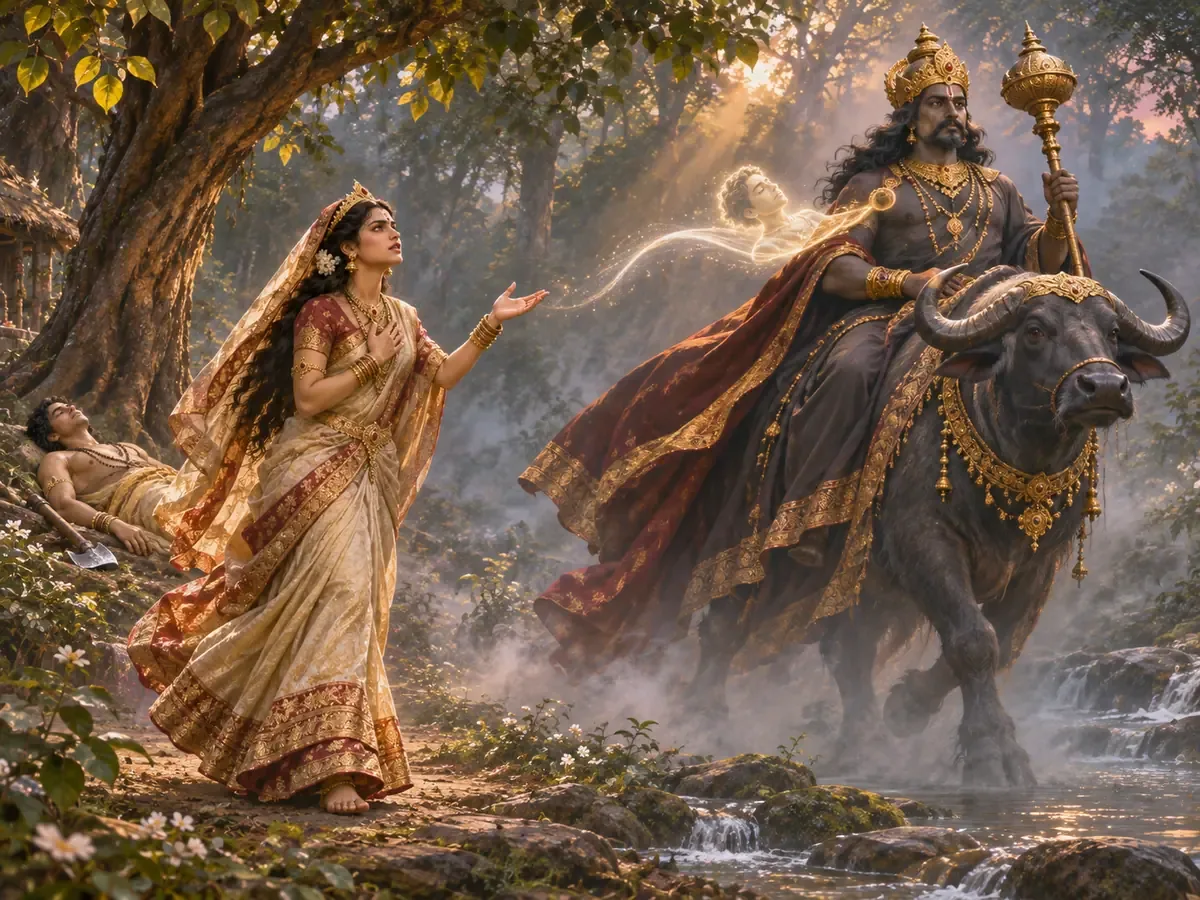
Yama told her that her duty to her husband had been fulfilled and that she should return to perform the rites for his body. But Savitri continued. She spoke of the path shared by husband and wife, of the force of discipline and devotion, and of the worth of good companionship. Even seven steps taken together, she said, could establish a bond of friendship.
Yama was pleased by her thoughtful words and offered her a boon, with one restriction: she must not ask for Satyavan's life.
Her first request was for Dyumatsena. The blind, exiled king should recover his sight and strength. Yama granted it. *(297.26–28)*
He again urged her to return. Savitri continued beside him and spoke of the unfailing value of the company of the good.
Her second request was that Dyumatsena regain his kingdom, without departing from dharma. Yama granted this too. *(297.29–33)*
Still she followed. Savitri spoke of compassion: the duty not to injure living beings in thought, speech or action, and the goodness of offering help without hostility. Her words pleased Yama again.
Her third request was for her father, Ashvapati, who had no sons. She wished him to have a hundred worthy sons to continue his line. Yama granted the boon. *(297.34–39)*
Yama again tried to dismiss her, but Savitri's words remained measured. She spoke of trust, truth and the conduct of those who uphold dharma. Yama offered another boon.
Her fourth request was for herself and Satyavan: that the two of them should have a hundred sons. Yama granted it. *(297.40–46)*
Savitri continued to praise righteous conduct, truthful speech and the generosity of the good. Yama was moved by the depth and consistency of her reasoning. He invited her to ask an exceptional final boon.
Now Savitri brought the earlier promise into focus. She had been promised sons with Satyavan, yet Satyavan had been taken from her. She asked that he live again, so that Yama's own words could come true. Without Satyavan, she said, the happiness she had been offered could not be fulfilled. *(297.47–54)*
Yama accepted her final request. He released Satyavan from the noose and declared that he would live a long life with Savitri. Yama's promise included four hundred years and the future children already foretold. *(297.55–60)*
The story does not portray Savitri defeating Yama through force. Her courage lies in following him, speaking without abandoning respect, and drawing the consequences of his own righteous promises into the light.
A Return Through the Night
Vana Parva 297.61–111 · PDF pp. 2000–2007
After Yama departed, Savitri returned to the place where Satyavan's body lay. She sat beside him and raised his head once more onto her lap.
Satyavan opened his eyes as if waking from a long and unfamiliar sleep. He remembered the fierce pain in his head and the strange dark figure who had drawn him away. Savitri told him that Yama had come and gone, and that they must now consider the darkness gathering around them.
Satyavan was troubled by how late it had become. His parents, already burdened by age and exile, would be anxious. He grieved at the thought of the distress his absence might cause them.
Savitri reassured him. When he was ready to walk, she left the basket of fruit upon a branch, took the axe, and supported him with her shoulder. Satyavan recognised the forest path by familiar landmarks and the light visible between the trees. Together they made their way back to the hermitage.
The road that had carried them toward the hour of death now led them home.
The Promises Fulfilled
Vana Parva 298.1–44 and 299.1–17 · PDF pp. 2008–2019
That very evening, Dyumatsena's sight returned. Yet the restored gift of vision could not quiet his anxiety: Satyavan had not come home. He and his wife Shailya searched the forest and the nearby hermitages, calling for their son. The sages brought them back and offered consolation, affirming their confidence in Satyavan's return.
At last Savitri and Satyavan arrived. The hermitage rejoiced. Everyone wondered why they had been delayed, and why Dyumatsena could suddenly see.
Satyavan could speak only of his pain, his long sleep and his return. When the elders questioned Savitri, she explained Narada's prophecy and the encounter with Yama. She told them of the boons: sight for Dyumatsena; the recovery of his kingdom; sons for her father; sons for herself and Satyavan; and the return of her husband's life.
The next morning, messengers from the Shalva country came to Dyumatsena. The enemy who had taken his kingdom was dead, they reported, and the people wished their former ruler to return. Dyumatsena went back and was installed again as king, while Satyavan was appointed heir to the throne.
In the years that followed, the other promises were fulfilled. Ashvapati had a hundred sons by Malavi, and Savitri and Satyavan were blessed with a hundred sons of their own.
Here Markandeya returned to the reason for telling the story. He had spoken to Yudhishthira, who grieved for Draupadi and the troubles of his family. Just as Savitri upheld her husband and his household through courage and steadfastness, Markandeya told him, Draupadi would help the Pandavas through their trials. Comforted, Yudhishthira set aside some of his sorrow.
Thus the Mahabharata's account ends not only with Satyavan's life restored, but with a counsel to a troubled king: righteousness, courage and clear-minded devotion are never without significance, even when the future appears dark.
---
EDITORIAL REFLECTION / PAUSE & REFLECT
Steadfast courage.
Words shaped by dharma.
Savitri knows the danger before she chooses her path. Her resolve does not become an act of force against Yama; it takes the form of patient reasoning and fidelity to the promises he has already made. How can firm conviction and respectful speech work together when facing a difficult truth?
This reflection is an editorial invitation, not a verse from the Mahabharata.
TEXT & INTERPRETATION
The Savitri Upakhyana
This complete English retelling follows the owner-supplied Gita Press Mahabharata, Volume 2, Vana Parva, Pativrata-Mahatmya Parva, chapters 293–299 (PDF pages 1963–2019). The seven reader chapters preserve Markandeya's framing, Savitri's choice, her three-day observance, Yama's four preliminary boons and the final restoration of Satyavan's life.
The narrative is an original English prose adaptation approved for this site, not a verbatim or line-by-line translation of the Sanskrit verses or Gita Press Hindi commentary. Chapter and verse references follow this supplied edition; a Southern-recension addition is noted by the edition near chapter 297. The images are artistic interpretations of moments from the account, not documentary reconstructions.
Read the verse map and supplied-edition notes