Places hold stories in a different way: through rivers, shrines and the communities that care for them. Begin with two illustrated centres of pilgrimage, then follow three additional text-first journeys grounded in the supplied scriptures.
01 / ON THE GANGA
Varanasi
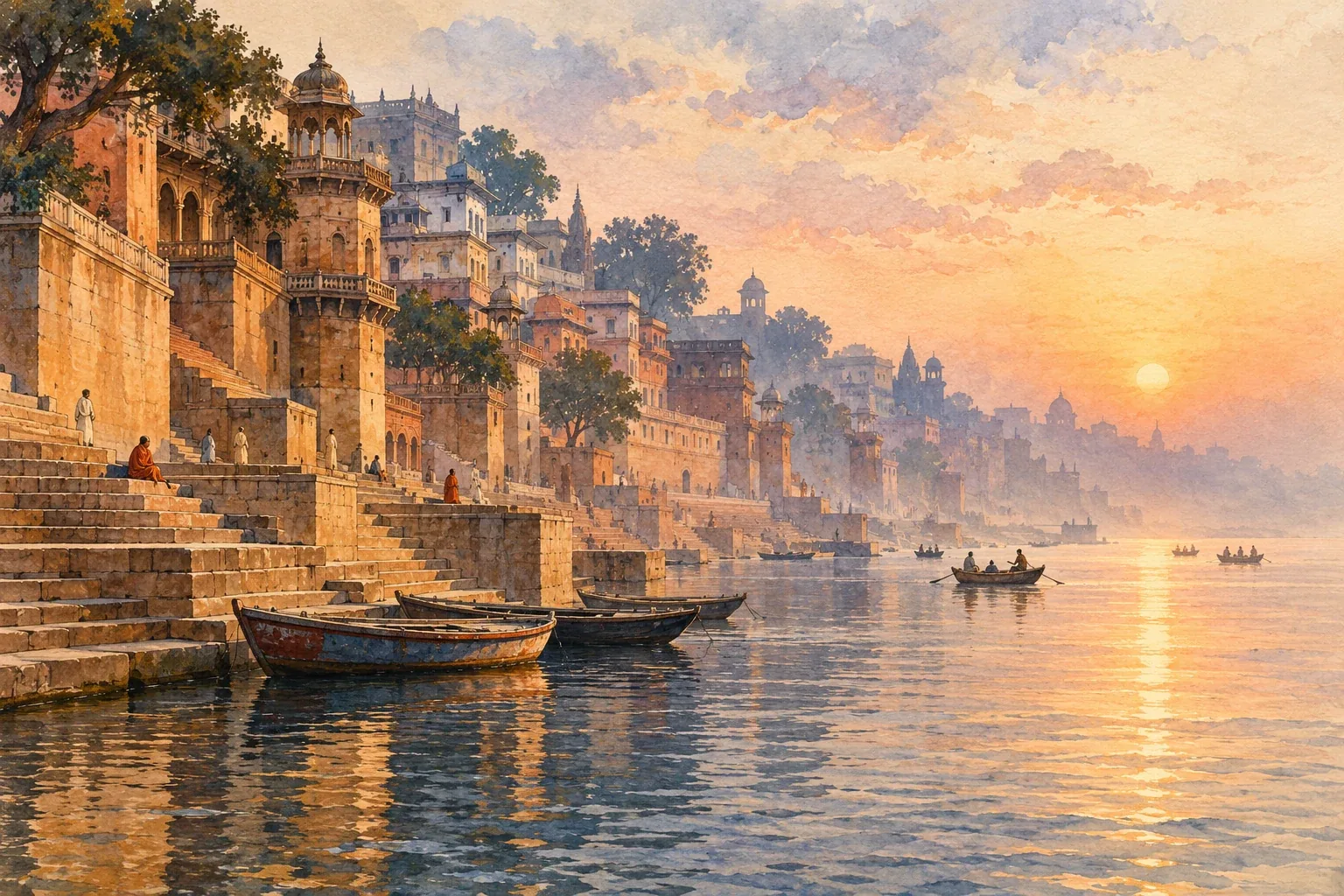
A riverfront inspired by Varanasi
Also known as
Kashi and Banaras
Location
Uttar Pradesh, northern India, on the River Ganga
A shrine to explore
Shri Kashi Vishwanath, dedicated to Shiva and revered as a jyotirlinga shrine
Varanasi’s riverfront brings pilgrimage, worship and everyday life into close proximity. Ghats form the city’s meeting places with the Ganga; narrow lanes lead into its temple landscape.
Shiva and the river
The Kashi Vishwanath shrine offers a connection to Shiva’s devotional world. The Ganga offers another doorway into the stories: in the Ramayana’s account of Bhagiratha, Shiva receives the river’s descent before she follows the king onward.
This is a reading connection between a sacred river and a narrative in the collection. The Bhagiratha story describes the river’s descent, rather than a historical account of Varanasi.
The Kashi-khanda presents Kashi as the domain of Vishveshvara and associates its sacred landscape with liberation. It connects the name Varanasi with Asi and Varana; a note in the supplied edition identifies this as a popular etymology. Manikarnika and the celestial river also appear in the text’s praise of the city.
These passages describe a devotional geography. They do not establish the historical origins of present-day buildings or ghats.
Ramanathapuram district, Tamil Nadu, on Rameswaram island
A shrine to explore
Ramanathaswamy Temple, where Shiva is worshipped as a jyotirlinga
Story connection
Local traditions of Rama’s worship of Shiva
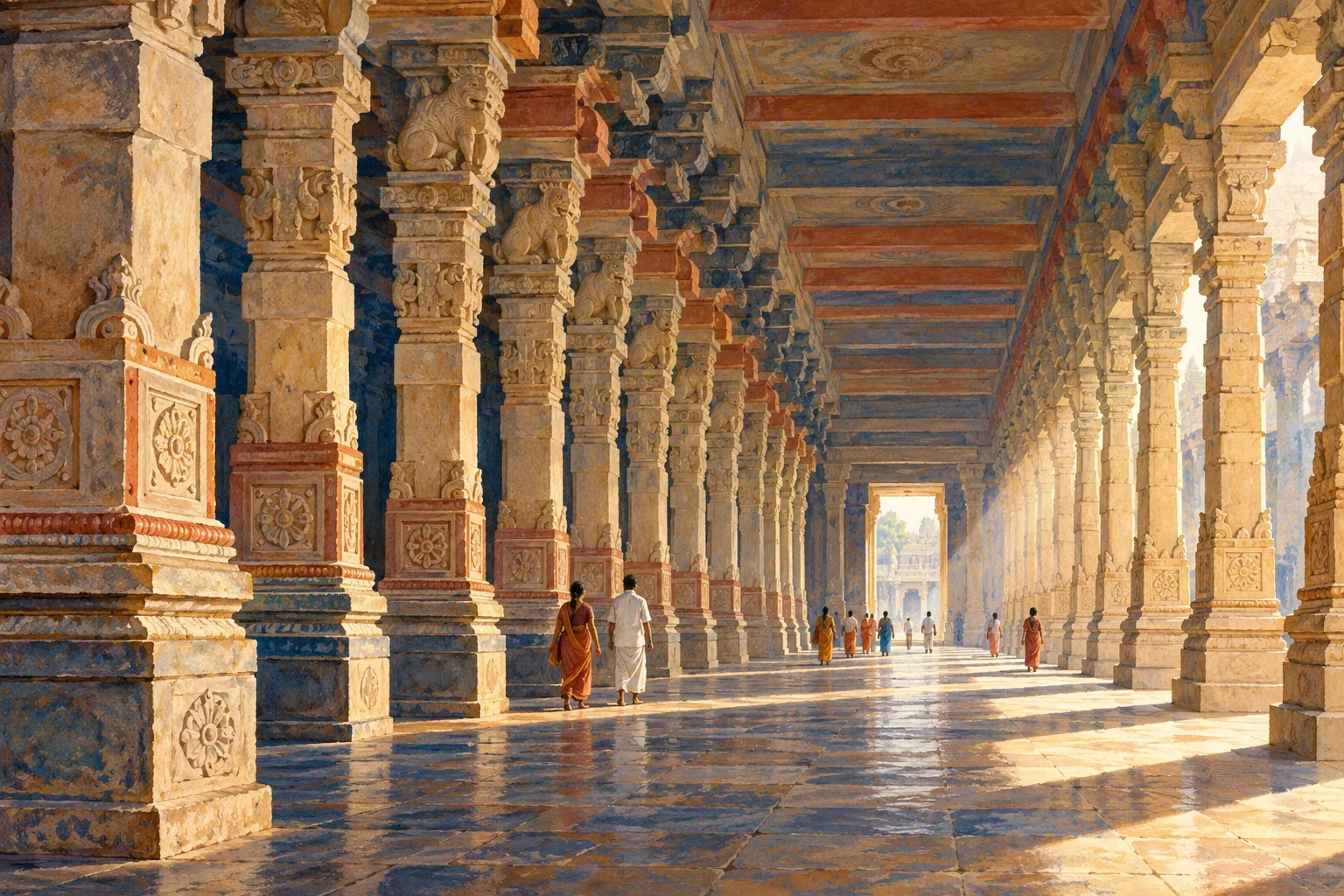
The Ramanathaswamy Temple is known for its long corridors and carved pillars. Its sacred setting connects the worship of Shiva with traditions of Rama and the journey to Lanka.
A meeting of devotional worlds
The district’s official account records the belief that Rama sanctified the place through worship of Shiva, and identifies its importance to both Shaiva and Vaishnava devotees. This is a local sacred tradition, distinct from the ocean-crossing chapter followed in our Hanuman reader.
Read Hanuman’s journey for the search for Sita, then explore Rameswaram as a place where Ramayana memory and Shiva worship meet. The connection invites comparison without placing every local tradition into the same textual account.
The Setu-mahatmya praises the Shiva linga associated with Rama. It describes Rama as its installer and worshipper, and connects Ramanatha’s presence with liberation. A note in the supplied edition explains that Ramanatha and Ramesvara are names for the same linga.
This belongs to the Skanda Purana’s sacred account of Setu. It remains distinct from the Valmiki Ramayana narrative and from the later architectural history of the temple.
The Skanda Purana's Purushottama-ksetra-mahatmya describes a sacred landscape associated with Jagannath, Balabhadra and Subhadra. Its account of the chariot festival follows a procession toward the Gundicha pavilion.
The described route is prepared with water, flowers, music and banners. Here, the public journey is an act of devotion, not a claim about the present-day architecture or the entire history of Puri.
FOLLOW THE TEXT
The Ratha Yatra account
Skanda Purana, Part 5, Vaishnava-khanda, Purushottama-ksetra-mahatmya, II.ii.33.28–41 and II.ii.34.1–11. The accompanying source review distinguishes Balabhadra from Rama of the Ayodhya narrative.
Ayodhya is the royal home from which Rama departs in the Valmiki Ramayana's Ayodhya Kanda. The exile account explores Rama's acceptance of a difficult family obligation and the choices of Sita and Lakshmana to accompany him.
A separate account in the supplied Skanda Purana's Ayodhya-mahatmya associates a place of Rama's birth with a Navami observance, bathing, worship and giving. This is devotional sacred geography, not independent evidence about the age or origin of modern structures.
TWO TEXTS, DISTINCT CONTEXTS
Epic narrative and pilgrimage
Read Valmiki's exile story for its epic context; consult Skanda Purana, Part 7, Vaishnava-khanda, Ayodhya-mahatmya, II.viii.10.18–25, for this specific pilgrimage passage. The latter does not provide enough detail to infer a complete festival date.
In the Bhagavata Purana's account, Govardhana Hill becomes a shelter when Krishna protects the people and cattle of Vraja from the storm. The narrative of protection and humility appears in Bhagavata Purana 10.24–27.
A separate festival passage in the supplied Skanda Purana, Part 6, describes worship of Govardhana alongside honouring cows and bulls. The narrative and the festival instruction are presented here as related but distinct textual settings.
FROM PLACE TO PRACTICE
Govardhana and the pastoral community
The festival account is Skanda Purana, Vaishnava-khanda, Karttikamasa-mahatmya, II.iv.10.23–26. The supplied edition's note associates the hill with Krishna's protection of the inhabitants of Vraja.