

The question beneath achievement
Vyasa has studied, taught and composed a work concerned with the aims of life, yet he remains inwardly dissatisfied. Narada visits his hermitage carrying a vina and asks a direct question: are body and mind truly content?
Vyasa does not defend his achievements. He admits that something remains incomplete and asks Narada to identify it. Narada answers that knowledge and action have not yet been gathered fully around praise of the Divine. He urges Vyasa to narrate the Lord’s deeds for people who are repeatedly burdened by suffering.
The counsellor does more than diagnose. He explains why he trusts the transforming power of hearing—and begins with a life in which he had neither learning nor status.
A child among travelling sages
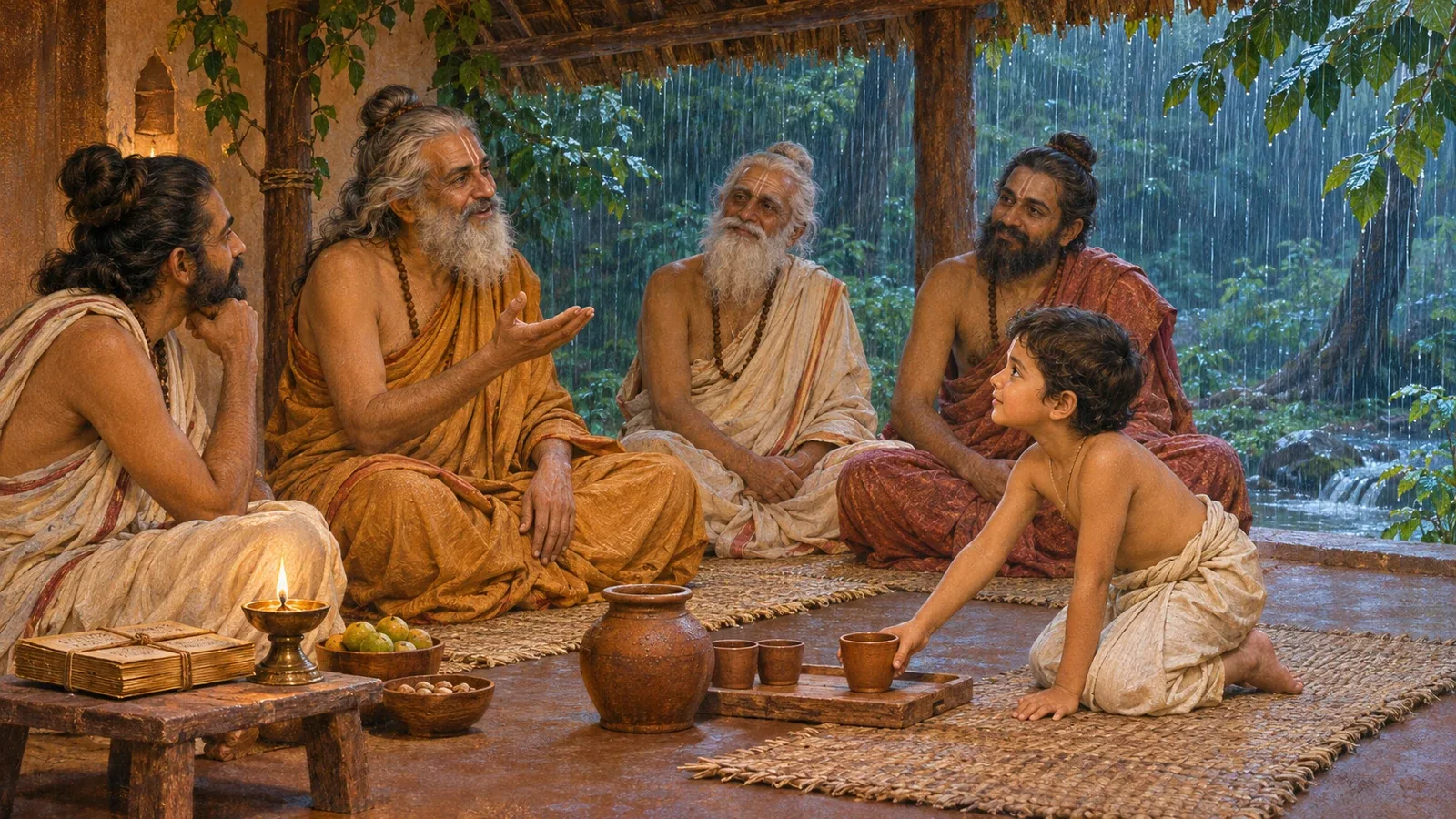
In a former cosmic age, Narada says, he was the young son of a maidservant. During the rainy season, travelling sages stayed in one place, and the child was assigned to serve them. He listened, followed their direction and spoke little.
With their permission, he ate the remnants of their food. More important to the narrative, he heard them sing and speak each day about Krishna. Service became attention; attention became delight in what he heard. Across the rainy and autumn seasons, devotion began to take root.
When the sages prepared to leave, they did not leave the child with admiration alone. They gave him instruction concerning the Divine and the offering of one’s work. Guidance here begins in relationship: they notice his steadiness, respond with care and equip him to continue without them.
Loss and the road north
The child remains with his mother, who loves him deeply but has little control over the conditions of their life. One night, while she is outside tending to a cow, a snake bites her and she dies. The account states the loss briefly. It does not make grief unreal; it shows the child interpreting a terrible change as an opening to follow the direction he has received.
Alone, he travels north. He passes settlements, fields, mines, gardens, mountains and bodies of water before entering a vast forest. The long landscape matters: borrowed teaching is becoming a path he must walk for himself.
Exhausted and thirsty, he bathes and drinks from a river pool. In the solitude beyond it, he sits beneath a pipal tree and turns inward according to what the sages taught him.
A glimpse beneath the tree
As the child meditates, longing and tears fill him. The presence he seeks appears within his heart, bringing an overwhelming joy—and then disappears. He tries to recover the vision but cannot summon it through effort.
A voice answers his distress. The glimpse, it explains, was given to deepen his longing; he will not see that form again in this life. Yet the devotion awakened through the sages’ company will remain firm, even through the dissolution of the created worlds.
From then on the child moves through the earth remembering and singing the divine names and deeds. The encounter does not make him a possessor of visions. It gives his longing a direction and his life a practice.
A life carried across a cosmic turning
At the end of that embodied life, Narada says, he receives a purified form. When the cosmos is withdrawn, he enters with Brahma into Narayana; when Brahma rises again to create, Narada appears with the other sages.
This is the “birth” remembered in the Bhagavata account: not a modern biological biography assembled from every tradition, but continuity through death, dissolution and a new act of creation. The memory of devotion is preserved across that turning.
By divine grace, Narada can then travel without obstruction through the worlds. His vina, given by the Divine and joined to sacred sound, becomes the companion of his vow: he moves while singing the Lord’s deeds.
Guidance without possession
The Bhagavata repeatedly shows Narada arriving at a moment when someone’s life has become a question. With Vyasa, he names an incompleteness hidden beneath accomplishment. He does not write the needed work for Vyasa; he helps the sage see what his own work must become.
With Dhruva, Narada first tests whether the hurt child can release his fierce resolve. When Dhruva answers honestly, Narada does not shame him. He gives the journey a place, a form of worship and an object of contemplation, then reassures the anxious father left behind.
In Prahlada’s account, Narada shelters Kayadhu and teaches while Prahlada is still in the womb. Prahlada later remembers that instruction among his classmates. Across these episodes, guidance does not create dependence on the guide; it awakens a relationship the seeker must live.
The teacher who keeps moving
Narada describes the song of the vina not as ornament but as a way of remembrance. When he sings the Lord’s deeds, the presence he loves returns within his heart. From that experience he tells Vyasa that sacred narration can become a vessel for minds repeatedly wounded by craving and fear.
Then he leaves. The chapter closes with Narada sounding the vina as he travels freely, while Vyasa turns toward the work before him. A good guide has changed the direction of the room without making himself its centre.
The movement joins Narada’s beginning to his deeds. He first received devotion by serving, hearing and remembering. He later offers spiritual guidance in the same pattern: he arrives, listens, speaks what the moment requires and leaves another person able to continue.
EDITORIAL REFLECTION / PAUSE & REFLECT
Guidance that does not hold.
Listening that becomes a life.
Which teaching in your life became real only after you had to carry it without the teacher beside you? Narada’s remembered childhood suggests that spiritual guidance is completed not by dependence, but by attentive practice.
TEXT & INTERPRETATION
One remembered life.
Selected deeds, clearly separated.
The central narrative follows only the supplied Gita Press Bhagavata Purana 1.5–6. The Dhruva and Prahlada sections are identified as later appearances in 4.8 and 7.7, not folded into a single uninterrupted chronology.
The Narada Purana is a distinct Mahapurana named for Narada; it is not treated here as the source of this birth account. The divine encounter, cosmic transition and unobstructed travel belong to the Bhagavata’s devotional theology. The page’s language about guidance without possession is editorial reflection.
The child, sages, hermitage, adult Narada, landscape and celestial path in the paintings are imagined. They are devotional interpretations, not historical reconstructions.
Read the supplied-edition verse map