
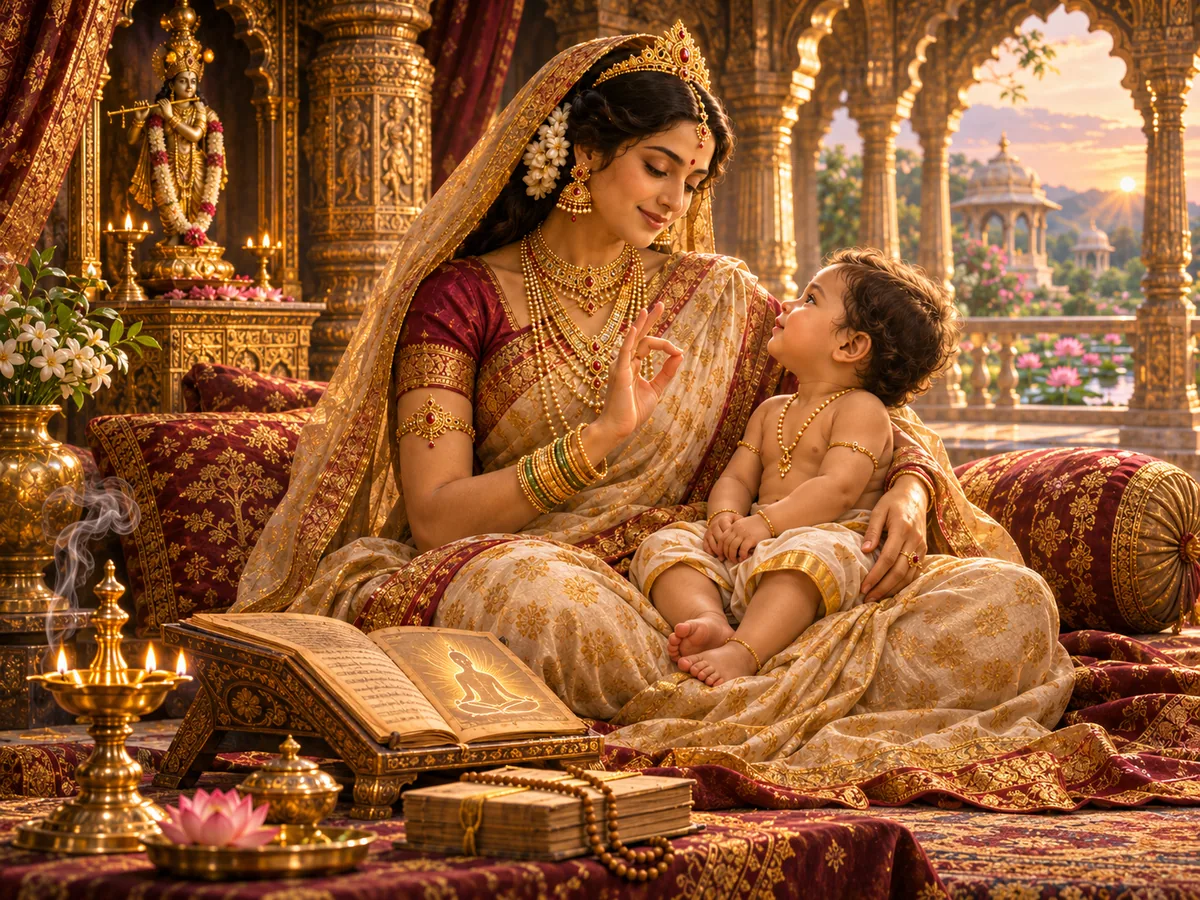
A homecoming no one had expected
Canto XXIV.42–43; XXV.1–8 · supplied PDF pp. 186–187
The story begins after a sorrowful separation. Prince Ritadhvaja, also known as Kuvalayashva, believed that his beloved Madalasa had died. Through the intervention of the Naga king Ashvatara, he was reunited with her. On his return, the prince explained the extraordinary encounter to his parents. Madalasa greeted her new family with affection and respect, and the people of the city celebrated the couple’s return.
They spent peaceful years together. Ritadhvaja’s father, King Shatrujit, eventually died, and Ritadhvaja was installed as king. The narrative describes him protecting his subjects as carefully as his own children. In time Madalasa gave birth to their first son.
The child was welcomed by the royal household. His father named him Vikranta, a name meant to evoke a mighty warrior. The attendants rejoiced. Yet Madalasa laughed gently—not because she rejected her son, but because the name prompted her to consider something deeper than royal identity. As she spoke to the infant, the story’s central teaching began.
The first lesson beside a cradle
Canto XXV.9–15 · supplied PDF p. 187
The baby cried as children do. Madalasa looked at him and spoke with the intimacy of a mother comforting her child. But her words were not simply a promise that the crying would end. She invited him to look beyond the body whose needs had brought him into the world.
The body, she explained, is assembled from the elements. It changes through food, water and the course of time. Names and titles are bestowed after birth; they do not reveal the full nature of the one who receives them. The son of a king is called a prince, yet the Self is not made royal merely by that designation.
She did not deny that family, hunger and growth belong to a human life. Rather, she asked the child not to mistake these passing conditions for the whole truth of who he was. A body grows and diminishes; affection binds people to one another; gain and loss follow each other. Beneath these changing experiences, her teaching pointed toward the Self.
The scene is remarkable for its setting. Such questions are often expected in a forest debate or before a learned sage. Here they arise in a mother’s tenderness toward an infant who cannot yet answer.
What changes, and what does not
Canto XXV.14–18; XXVI.1–3 · supplied PDF pp. 187–188
Madalasa continued by describing the hold that pride, desire and identification can exert over the mind. People cling to the body as though its forms would never alter. They assign possessions, relationships and qualities to themselves, and then suffer when those arrangements change.
She wanted her first son to learn the difference between living through the world and being completely defined by it. The account does not say the child understood every word at once. It says that as he grew, his mother continued teaching him through conversation and daily guidance.
Over the years Vikranta developed knowledge of the Self and an inclination toward nonattachment. In the language of the text, he did not turn his heart toward the ordinary pursuit of domestic life. The first royal son, expected to inherit a worldly role, had instead been drawn toward an inward search.
The other children hear the same wisdom
Canto XXVI.4–7 · supplied PDF p. 188
Later Madalasa bore a second son. His father called him Subahu, praising strength and heroic form. Again the queen smiled at the meaning of the name. She taught this child as she had taught the first, and he too grew in understanding.
A third son was born and given the martial name Shatrumardana—the destroyer of enemies. Madalasa laughed again. Her teaching did not turn into a competition between the boys, nor did she speak of their royal birth as a reason for spiritual superiority.
The Purana describes her sons as becoming inclined toward detachment, their minds drawn to a knowledge deeper than ambition. What might have been an ordinary chronicle of princes and succession became an account of the different paths that children may take under a parent’s guidance.
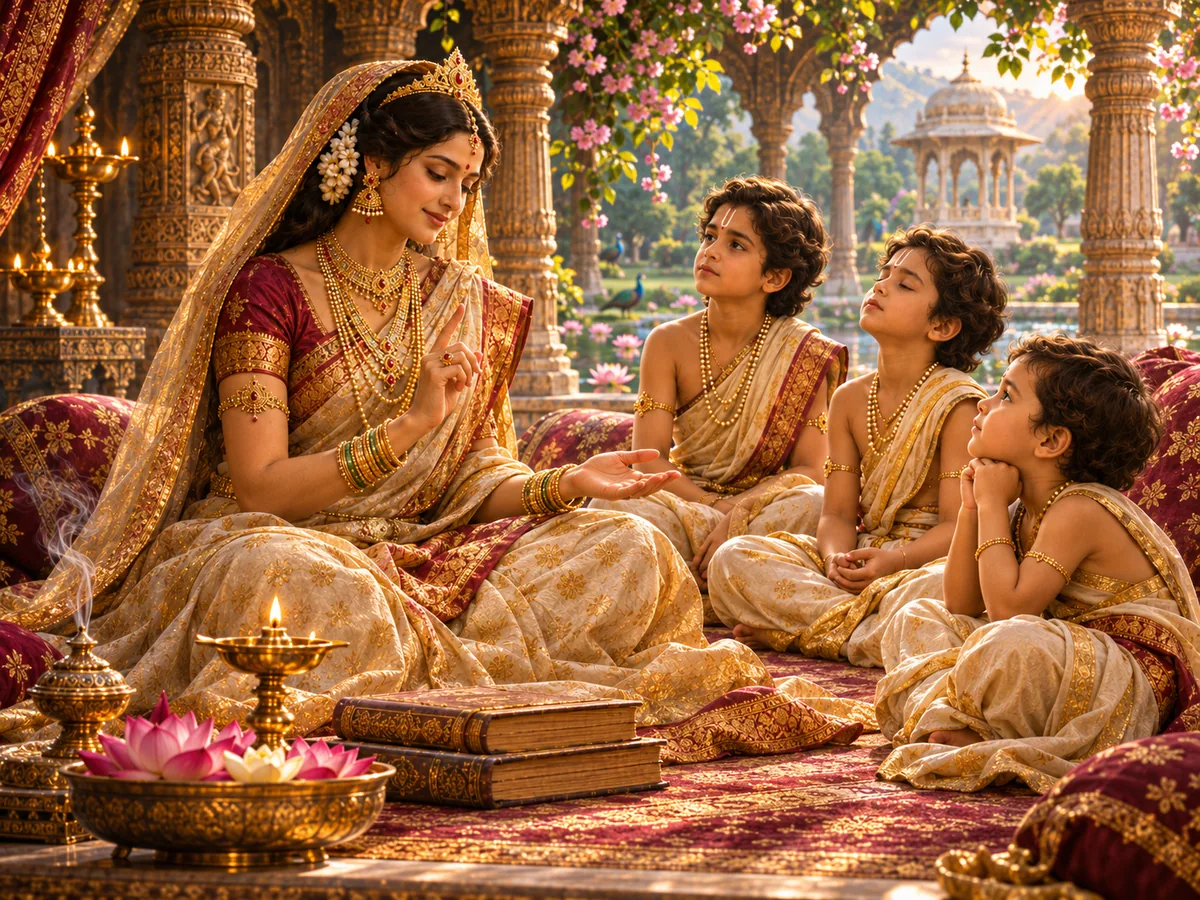
Why Madalasa laughed at their names
Canto XXVI.8–23 · supplied PDF pp. 188–190
When a fourth child was born, Ritadhvaja could no longer contain his curiosity. The names Vikranta, Subahu and Shatrumardana, he said, were splendid for members of a royal family. Why had Madalasa laughed each time? If she disliked the names he had chosen, she should name the youngest boy herself.
Madalasa answered with a name: Alarka. Her husband found it strange and asked what she meant by it. She then explained the laughter that had accompanied the others. A name for a powerful traveller, she observed, presumes movement; but the Self described by the wise is all-pervading. A name that praises strong arms belongs to a body; the Self has no physical limbs. A name that celebrates destroying an enemy concerns conflict between beings, yet the Self is not itself wounded by weapons.
These were not practical objections to every use of names. They were philosophical objections to confusing the visible person with the ultimate Self. If names were only conventions of worldly life, she reasoned, Alarka need not be dismissed simply because it sounded less heroic. The king listened and accepted her answer.
In this exchange, the Purana places two ways of seeing one person side by side: the father sees a prince who must live among other people; the mother sees an inner reality that cannot be confined to outward titles.
A father asks for a different education
Canto XXVI.24–33 · supplied PDF p. 190
Madalasa began to speak to Alarka as she had spoken to his elder brothers. But the king now intervened. He feared that if every son turned away from household life, no one would shoulder the family’s obligations or continue its duties.
His request belonged to the social world described by the Purana. A king, he argued, must learn how to protect people, maintain religious and family observances, provide for dependants and support the wider community. He asked that Alarka be instructed in action rather than educated only toward withdrawal.
The queen did not answer by abandoning what she had taught. Instead, she accepted the particular responsibility before her. The youngest child needed wisdom for a life of leadership. She would teach him to live in the world without surrendering his mind to it.
That turn is the heart of the episode: the mother who had taught three sons to recognize the Self now taught the fourth how to bear the burdens of a kingdom.
A blessing for the prince who would rule
Canto XXVI.34–39 · supplied PDF pp. 190–191
Madalasa offered Alarka a very different kind of cradle teaching. She wished him a long life in which he would protect the earth, aid his friends, uphold righteousness and bring honour to the people who depended on him. She spoke of teachers, kin, guests and the duties of a ruler.
She asked him to give attention to learning in youth and to the welfare of others in maturity. Protection, generosity, religious observance and the restraint of harmful conduct all belonged to the path his father had requested for him.
The language is that of ancient royal duty, including conflict and the protection of social institutions as the text understands them. It should not be mistaken for a set of instructions to modern readers. In the story, it marks the change from the teaching of personal detachment to the education of a future king.
Alarka grew older hearing these words. He came to recognize that a title could be held without allowing the title to rule the mind.
Before ruling a kingdom, rule the mind
Canto XXVII.1–16 · supplied PDF pp. 191–192
When Alarka reached the age of formal learning, he bowed before his mother and asked her to teach him how to attain well-being in this life and beyond it. Madalasa began not with conquest, wealth or the grandeur of a throne, but with responsibility.
A king must care for the people and remain faithful to his obligations. He must seek sound counsel, understand whom he trusts and resist decisions made in the heat of passion. It is not enough to possess advisers if their judgment is poor, or to command soldiers when the commander lacks self-command.
Then came the lesson she pressed most strongly: a ruler who has not subdued himself cannot expect to subdue danger outside him. Desire, anger, greed, arrogance and careless delight can overthrow a kingdom from within. She drew on older examples of rulers undone by these weaknesses, setting their failures against the stability that comes from restraint.
This was a form of self-knowledge different from the teaching she had offered her first three sons. For Alarka, understanding himself was not an escape from governing; it was the first condition for governing well.
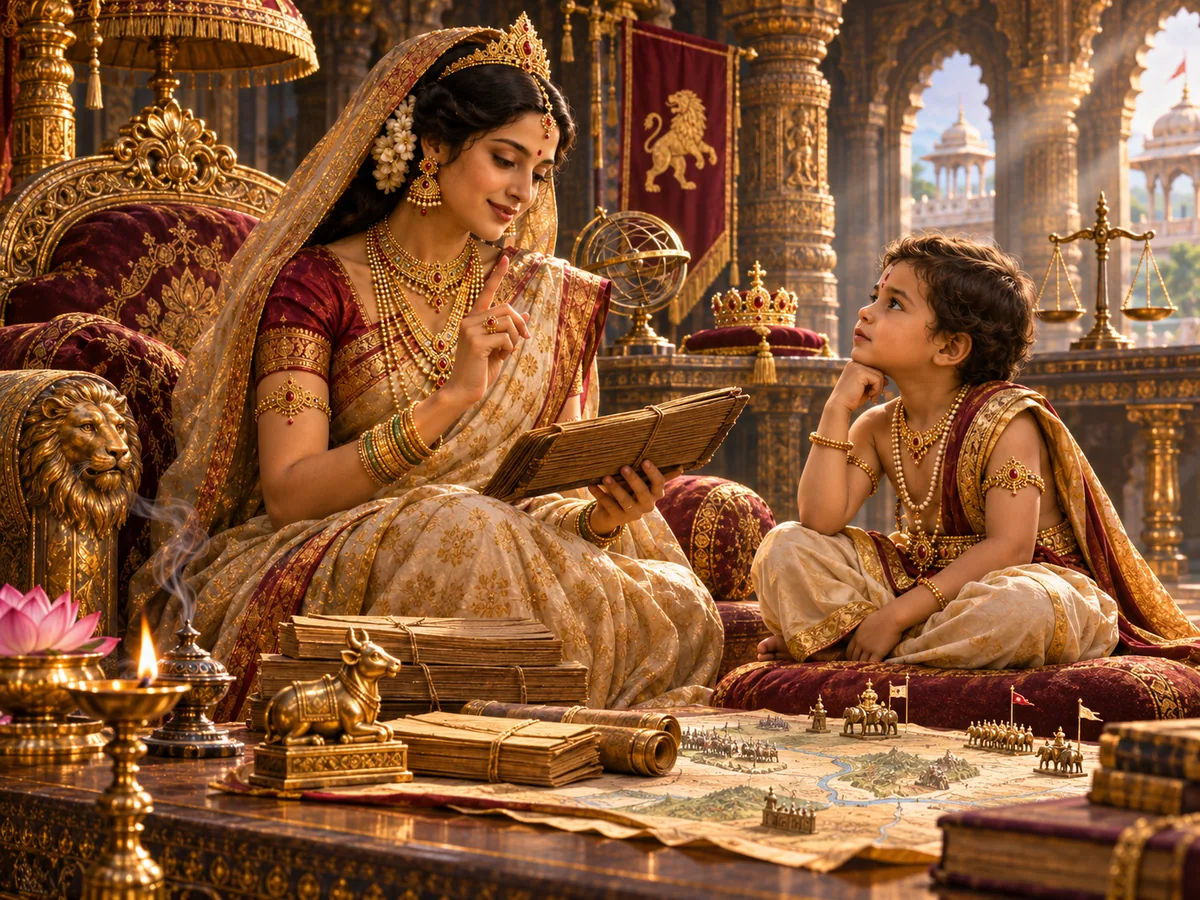
The world as a school for a king
Canto XXVII.17–31 · supplied PDF pp. 193–194
Madalasa turned from the faults of the heart to the signs that surround a thoughtful person. The passage names birds, insects, animals, the sun, the moon and the wind as images through which a ruler can think about his responsibilities. The examples are part of an ancient teaching on royal policy, not a natural-history treatise.
She spoke of Indra’s rain as an image for sustaining the people, of the sun gathering water as an image for carefully collecting resources, and of Yama’s impartiality as a model for justice. The moon suggested the peace that inspires affection; the unseen movement of the wind suggested a ruler’s need to learn what is happening throughout the kingdom.
One lesson was repeated through the variety: power must serve more than the ruler who holds it. Prosperity without fairness is fragile, and punishment without self-restraint is dangerous. A ruler was to protect people while keeping the same discipline in his own conduct that he expected in public life.
The queen had begun by asking what remains unchanged when everything else changes. She now asked how a person who understands his own weaknesses can act without bringing harm to others.
The duties of different ways of living
Canto XXVIII.1–31 · supplied PDF pp. 194–196
Alarka listened carefully and asked further questions. What duties should a ruler understand among the people, and how should he regard the different stages through which a human life may pass? Madalasa’s answer reflects the occupational and social classifications of the Purana’s historical setting.
She described the student’s discipline of learning under a teacher, the householder’s responsibilities of work and family, the forest-dweller’s movement toward simplicity, and the renunciant’s effort to loosen the hold of anger, possession and pride. Her account also sets out the text’s traditional categories of social duty; these are presented here as the beliefs expressed in this ancient passage, not as prescriptions for people today.
The distinction mattered for her argument. No single outward form exhausts a human life. A person may serve in a household, govern a community, study or seek renunciation. Each position brings demands that cannot be dismissed simply by speaking noble words about the Self.
Alarka was being prepared for the path of active responsibility. His mother did not ask him to forget spiritual inquiry. She asked him to carry it into the decisions that would shape the lives of others.
The kingdom begins at the household door
Canto XXVIII.32–36; XXIX.1–46 · supplied PDF pp. 197–201
At the end of her account of conduct, Madalasa named virtues that can be recognized beyond the particular roles of the people who practice them: truthfulness, purity, non-harm, freedom from envy, patience, compassion, generosity and contentment.
She then gave attention to the householder. The passage portrays family life as a network of obligations extending outward—to teachers, relatives, guests, those in need and living beings. In the Purana’s imagery, the householder supports a wide world through food, hospitality and observance. Its language of offerings and rites belongs to the text’s ritual context.
A hungry guest, she explained, must not be turned away without care. Someone who has enough should think of those who have less. The account specifically includes dependants, those suffering hardship, birds and other creatures among those whose needs should not be forgotten.
These teachings bring the episode back from kings and thrones to an ordinary doorway. In Madalasa’s instruction, the world is not served only through grand victories. Hospitality, restraint and attentiveness to vulnerability also give shape to responsibility.
The Purana continues Alarka’s education in later cantos. Our story closes here, with the contrast made clear: her first sons were guided toward inward detachment, while Alarka was taught to combine knowledge of the Self with the difficult work of caring for a kingdom.
EDITORIAL REFLECTION / PAUSE & REFLECT
What should knowledge
change in our actions?
Madalasa's sons do not all follow the same outward course. The episode asks whether knowledge of the Self must mean withdrawal, or whether it can guide a life of service. For Alarka, the first test of power is how he governs himself.
- Why does Madalasa find worldly names inadequate to describe the Self?
- Why does Ritadhvaja ask for an education in duty as well as detachment?
- How might restraint and care for guests or dependants change a ruler's decisions?
These questions are editorial invitations to reflection, not quotations from the Purana.
TEXT & INTERPRETATION
One mother. Different paths.
Edition: F. E. Pargiter's English translation of the Markandeya Purana, Cantos XXIV–XXIX, as preserved in the owner-supplied PDF, pp. 184–201. This original English prose retelling follows Cantos XXV–XXIX; its opening recalls the conclusion of Canto XXIV. Chapter numbering may differ in other editions.
This account contains teachings framed within the social roles and ritual assumptions of its textual setting. They are described as features of the source, not prescribed as obligations for contemporary readers. The celebrated 'Madalasa lullaby' circulated in other renderings is not presented here as a verified direct quotation: dialogue throughout this retelling is paraphrased.
All four images are cinematic artistic interpretations, not depictions of identified historical people or architecture. The original uploaded source PDF is not republished.
Read the source-by-canto map and editorial notes